Primer
Population Ageing in High-Income Countries: A Primer
Why populations are ageing, how ageing is measured, what it means for pensions, health care and labour markets — and what policy can and cannot change.
Summary
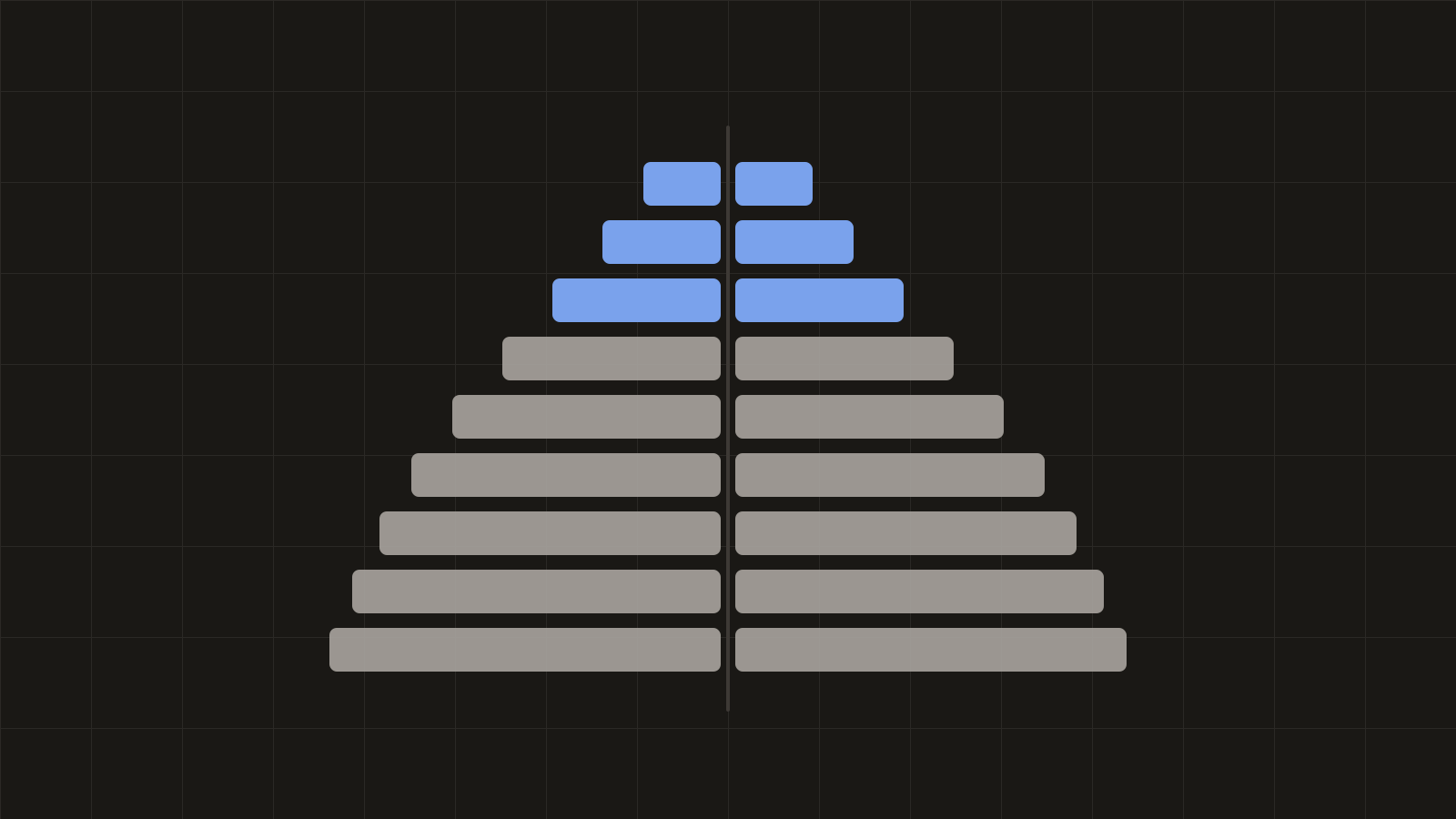
Populations age when people live longer and have fewer children. Nearly every high-income country now combines rising life expectancy with fertility below the replacement level of roughly 2.1 births per woman, shifting population structure toward older ages. The change is gradual, highly predictable over decades, and consequential for pensions, health systems and labour supply. Policy can shape how societies adapt to ageing far more than it can reverse the trend itself.
Key takeaways
- Population ageing is driven by two forces: rising longevity and fertility below the replacement level of about 2.1 births per woman.
- Standard measures include the share of the population aged 65 and over, the median age, and the old-age dependency ratio; conclusions can shift depending on which is used and how “working age” is defined.
- Japan has the oldest population among major economies, with roughly three in ten residents aged 65 or over.
- Ageing that took more than a century in early-industrialising countries such as France is now unfolding within a few decades in parts of East Asia and other later-developing regions.
- Migration and family policy can moderate ageing but rarely reverse it; adaptation — pensions, participation, productivity, care systems — is where policy has most leverage.
#What population ageing is
Ageing is often discussed as if it were a surprise. It is the opposite: because everyone who will be 65 in the year 2060 has already been born, the broad outline of population ageing is among the most predictable facts in social science. Uncertainty attaches to the margins — future fertility, migration and longevity gains — not to the direction of travel.
#How ageing is measured
The standard indicators
- Share aged 65+
- The percentage of the population aged 65 or over — the simplest headline measure of ageing.
- Median age
- The age that splits the population in half; it summarises the whole age distribution in one number.
- Old-age dependency ratio
- People aged 65+ per 100 people of working age. Definitions of “working age” vary (commonly 15–64 or 20–64), which changes the ratio substantially.
- Total fertility rate (TFR)
- The average number of children a woman would have under current age-specific birth rates. Replacement level is about 2.1 in low-mortality countries.
Each indicator answers a slightly different question, and headline claims often depend on the choice. A country can have a rising 65+ share while its dependency ratio is temporarily flattered by a large working-age cohort; “working age” cut-offs of 15, 20 or 65 are conventions, not facts about people’s actual working lives. Careful analysis states the definition being used — a habit we examine across statistics in Why Definitions Decide Debates.
#Why populations age
Two long-run forces drive ageing. The first is rising longevity: global life expectancy at birth has risen from below 50 years in 1950 to roughly 73 years today, according to United Nations estimates, with high-income countries typically above 80. The second is fertility decline: the global average has fallen from around five births per woman in the early 1960s to a little over two today, and nearly all high-income countries are below the replacement level of about 2.1.
A third mechanism, population momentum, shapes the timing: age structures change slowly, so today’s births and deaths echo decisions and conditions decades old. Even if fertility rose to replacement level tomorrow, populations would continue ageing for decades because the large older cohorts are already in place.
#How fast it is happening
The pace of ageing differs sharply across countries. In France, the share of the population aged 65 and over took more than a century to double from 7% to 14%. In parts of East Asia the same transition has occurred, or is occurring, within roughly a quarter of a century. Japan currently has the oldest population among major economies, with about three in ten residents aged 65 or over; South Korea, with the world’s lowest fertility rates in recent years, is projected to age exceptionally quickly.
Speed matters as much as level: countries that aged slowly built pension and care systems over generations, while fast-ageing countries must adapt institutions within a single working lifetime — often at lower income levels than early-ageing countries enjoyed.
#What ageing means in practice
- Pensions. Pay-as-you-go systems transfer income from workers to retirees; a rising retiree-to-worker ratio requires some combination of higher contributions, lower relative benefits, later retirement, or larger transfers from general budgets.
- Health and long-term care. Per-person health spending rises steeply at older ages, and demand for long-term care grows with the population aged 80 and over — the fastest-growing age group in most high-income countries.
- Labour markets. Slower or negative working-age population growth constrains labour supply, raising the economic weight of participation rates, skills, later retirement and productivity growth.
- Public finances. Age-related spending (pensions, health, care) forms the largest predictable pressure on long-run budgets in most high-income countries’ fiscal projections.
#What policy can and cannot change
Evidence from decades of policy experience supports a clear division. Policies aimed at reversing ageing have modest effects: family policies (parental leave, childcare, transfers) can support parents and may raise fertility somewhat, but no high-income country has durably returned to replacement level through policy alone. Migration lowers the average age and expands the workforce, but because migrants also age, plausible inflows moderate ageing rather than undo it — a conclusion reached, among others, by the United Nations’ well-known “replacement migration” calculations.
Policies aimed at adapting to ageing have far more leverage: raising effective retirement ages alongside healthy-lifespan gains, increasing labour-force participation, investing in productivity, prefunding parts of pension promises, and building long-term-care systems before peak demand arrives.
#How population projections work
Long-run population figures come from cohort-component projections: statisticians take today’s population by age and sex, then advance it year by year using assumed rates of fertility, mortality and migration. The United Nations’ World Population Prospects is the standard global source, publishing central estimates alongside variant scenarios. Projections are conditional statements — “if these rates hold, this structure follows” — and are most reliable over one to three decades, where most of the relevant people are already alive.
#Sources and further reading
- United Nations, World Population Prospects (population.un.org/wpp) — the standard global demographic estimates and projections, with full methodology.
- OECD — comparative work on pensions (Pensions at a Glance) and old-age dependency across member countries.
- Human Mortality Database (mortality.org) — detailed, validated mortality and population series for research use.
Terms used in this document
How to cite this primer
Helsen Institute for Public Research (2026). “Population Ageing in High-Income Countries: A Primer.” Helsen Institute Primer, published July 15, 2026. https://helsen-institute.vercel.app/research/population-ageing-primer
This work is licensed under CC BY 4.0. You may republish, translate, and adapt it — including for commercial purposes — with attribution to the Helsen Institute for Public Research and a link to https://helsen-institute.vercel.app/research/population-ageing-primer.
Related from the Institute
Explainer
Excess Mortality: What It Measures and Why It Matters
How excess mortality is defined and estimated, what it revealed during the COVID-19 pandemic and major heatwaves, and how to read the figures without being misled.

Explainer
Health System Models Compared: Beveridge, Bismarck, and Beyond
The four classic models of health system financing, which countries use them, why every real system is a hybrid, and what the labels do and do not explain.

Explainer
What Is Evidence-Based Policymaking?
Where the idea came from, what counts as evidence, the institutions built around it, and the honest limits of letting evidence guide public decisions.