Review
Measuring Public Trust in Institutions: Surveys, Findings, and Pitfalls
A review of the major surveys that measure trust in government, media and science, the findings that hold up across sources, and the methodological traps that produce misleading headlines.
Summary
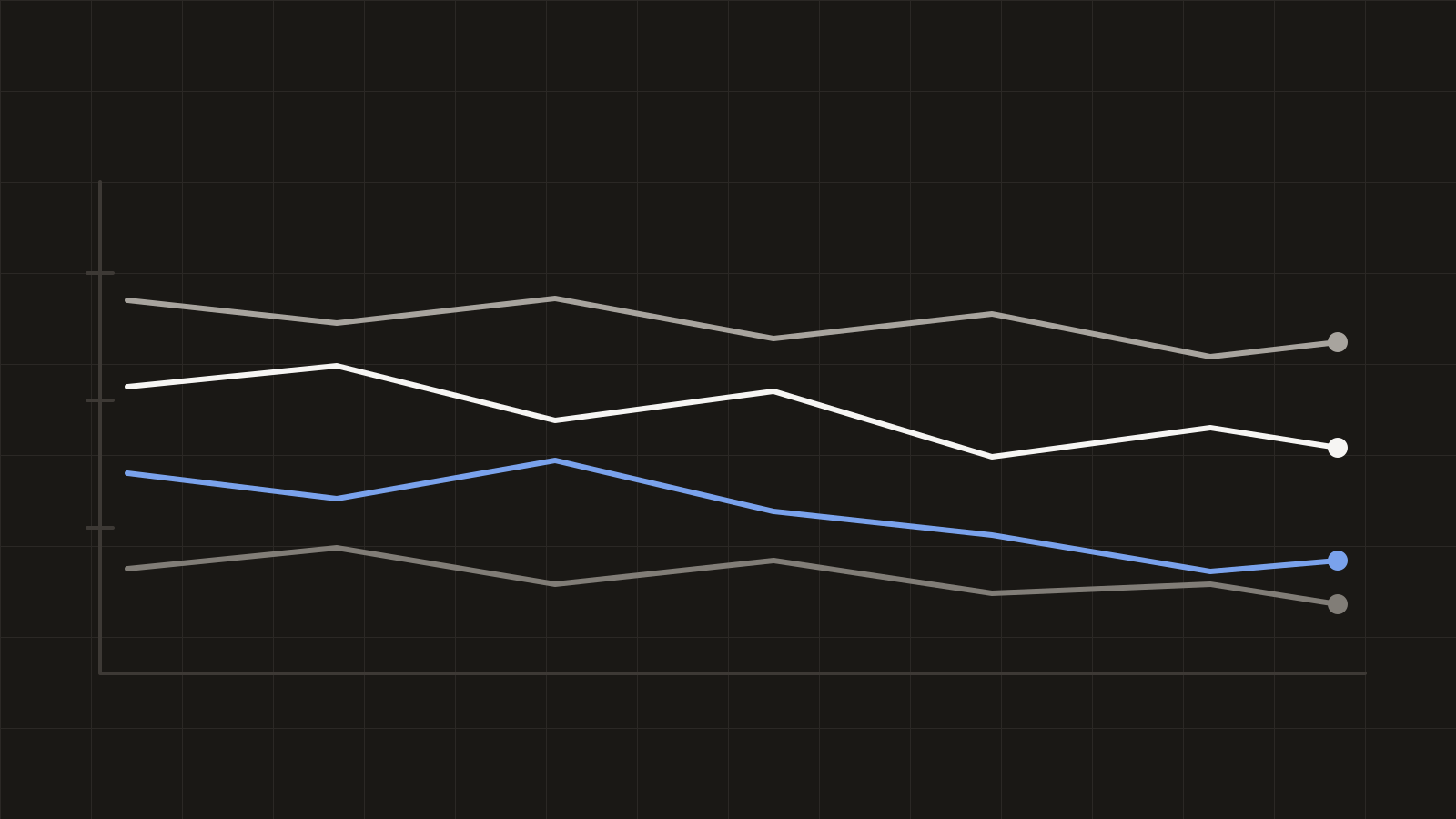
Public trust in institutions is measured by several long-running survey programmes — including the OECD Trust Survey, Eurobarometer, the World Values Survey, the Gallup World Poll and national series such as the US General Social Survey — which differ in question wording, scales and coverage. Some findings are robust across sources: trust varies enormously between countries, local institutions tend to be trusted more than national ones, and trust in the US federal government has declined markedly since the 1960s. But many dramatic headline claims rest on comparing incompatible surveys or misreading single-year movements as trends.
Key takeaways
- No single number measures “trust in institutions”; results depend on which institution is named, how the question is worded, and what response scale is used.
- Long-running sources include the OECD Trust Survey, Eurobarometer, the World Values Survey, the Gallup World Poll, the Edelman Trust Barometer and the US General Social Survey.
- Robust cross-survey findings: large and persistent differences between countries; higher trust in local than national government in many countries; markedly lower trust in the US federal government than in the early 1960s.
- Common errors include comparing levels across surveys with different questions, treating single-year movements as trends, and reading “trust in government” as if it covered all public institutions equally.
- A trust statistic should always be read with its question text, scale, population and year attached.
#Why measurement details matter
“Trust in institutions is collapsing” may be the most repeated empirical claim in contemporary politics. Whether it is true depends entirely on which institutions, which countries, which years and — critically — which survey. Trust questions are unusually sensitive to wording: asking whether people trust the government “to do what is right”, whether they “have confidence” in it, or whether they trust it “to use their data responsibly” yields different numbers from the same respondents.
This review documents the main measurement programmes and separates findings that replicate across them from artefacts of method. It is a companion piece to our explainer on reading statistics critically.
#The major surveys
| Survey | Run by | Running since | Coverage | Approach |
|---|---|---|---|---|
| OECD Survey on Drivers of Trust in Public Institutions | OECD | 2021 | 30+ OECD countries | 0–10 trust scales for government, civil service, parliament, courts, media; plus questions on drivers such as responsiveness and integrity |
| Eurobarometer | European Commission | 1970s | EU member states | “Tend to trust / tend not to trust” for national governments, parliaments and EU institutions |
| World Values Survey | WVS Association | 1981 | Global (waves) | Four-point “confidence” scale across many institutions; enables long-run and cross-cultural comparison |
| Gallup World Poll | Gallup | 2005 | 140+ countries | Binary confidence questions (national government, judiciary, military, media) |
| Edelman Trust Barometer | Edelman | 2001 | 25+ countries | Online survey of trust in government, business, media and NGOs; widely cited, methodology differs from official statistics |
| General Social Survey (US) | NORC, University of Chicago | 1972 | United States | Three-point “confidence in the people running” institutions battery; the longest consistent US series |
The Pew Research Center’s long-running compilation of US polling deserves separate mention: it tracks trust in the federal government “to do what is right” back to surveys from 1958, providing one of the few six-decade trend lines in existence.
#Findings that hold up across sources
- Between-country differences are large and persistent. Across surveys, trust in public institutions is consistently higher in, for example, the Nordic countries and Switzerland than in most other high-income democracies — differences of tens of percentage points that persist across decades and survey houses.
- Local beats national in many countries. The OECD Trust Survey and national studies repeatedly find higher trust in local government and in front-line public services than in national governments and parliaments.
- The long US decline is real. Trust in the US federal government fell from roughly three-quarters of the public in the early 1960s to around one-fifth to one-quarter in recent years — a decline visible across independent survey series, with the steepest fall in the 1960s–70s.
- Institutions differ more than eras. Within most countries, the gap between the most-trusted institutions (often science, the military, or the police, depending on country) and the least-trusted (often political parties and legislatures) is larger than most changes over time.
#Methodological pitfalls
- Cross-survey level comparisons. A 4-point confidence scale, a 0–10 scale and a binary question produce non-comparable percentages. Levels should only be compared within a survey; trends can cautiously be compared across them.
- Trend claims from short windows. Trust measures move with elections, scandals and crises (including a widely observed temporary “rally” early in the COVID-19 pandemic). One-year movements are weather, not climate.
- Bundling institutions. “Trust in government” often means the national executive; extending the claim to courts, civil servants or scientists is unsupported — these routinely score very differently.
- Mode and sampling effects. Online opt-in panels, phone samples and face-to-face surveys reach different populations; changes in mode can masquerade as changes in trust.
- Cultural response styles. Willingness to use scale extremes differs across countries, complicating fine-grained international rankings even within one survey.
#How to read a trust statistic
A defensible reading of any trust figure requires four attachments: the exact question text, the response scale (and which responses were counted as “trust”), the population and mode (who was asked, and how), and the comparison being made (same survey over time, or across countries within one wave). Claims that arrive without them — most viral charts — cannot be evaluated and should not be repeated.
#Sources and further reading
- OECD — Survey on Drivers of Trust in Public Institutions, main results reports (2022 and 2024), with full questionnaires and methodology.
- World Values Survey (worldvaluessurvey.org) — data and documentation for all waves since 1981.
- Pew Research Center (pewresearch.org) — the long-run “Public Trust in Government” series for the United States.
- Eurobarometer — the European Commission’s recurring surveys of trust in national and EU institutions.
- NORC General Social Survey — the US confidence-in-institutions series since 1972.
Terms used in this document
How to cite this review
Helsen Institute for Public Research (2026). “Measuring Public Trust in Institutions: Surveys, Findings, and Pitfalls.” Helsen Institute Review, published July 29, 2026. https://helsen-institute.vercel.app/research/measuring-public-trust
This work is licensed under CC BY 4.0. You may republish, translate, and adapt it — including for commercial purposes — with attribution to the Helsen Institute for Public Research and a link to https://helsen-institute.vercel.app/research/measuring-public-trust.
Related from the Institute
Explainer
What Is Evidence-Based Policymaking?
Where the idea came from, what counts as evidence, the institutions built around it, and the honest limits of letting evidence guide public decisions.
Explainer
Excess Mortality: What It Measures and Why It Matters
How excess mortality is defined and estimated, what it revealed during the COVID-19 pandemic and major heatwaves, and how to read the figures without being misled.
Primer
Randomised Controlled Trials in Public Policy: A Primer
Why randomisation is the cleanest route to causal claims, the landmark policy trials that proved the method’s worth, and the questions RCTs cannot answer.