Insight
Correlation, Causation, and How Public Debate Confuses Them
Why associations mislead, the three classic mechanisms behind spurious findings, and what it actually takes to support a causal claim.
Summary
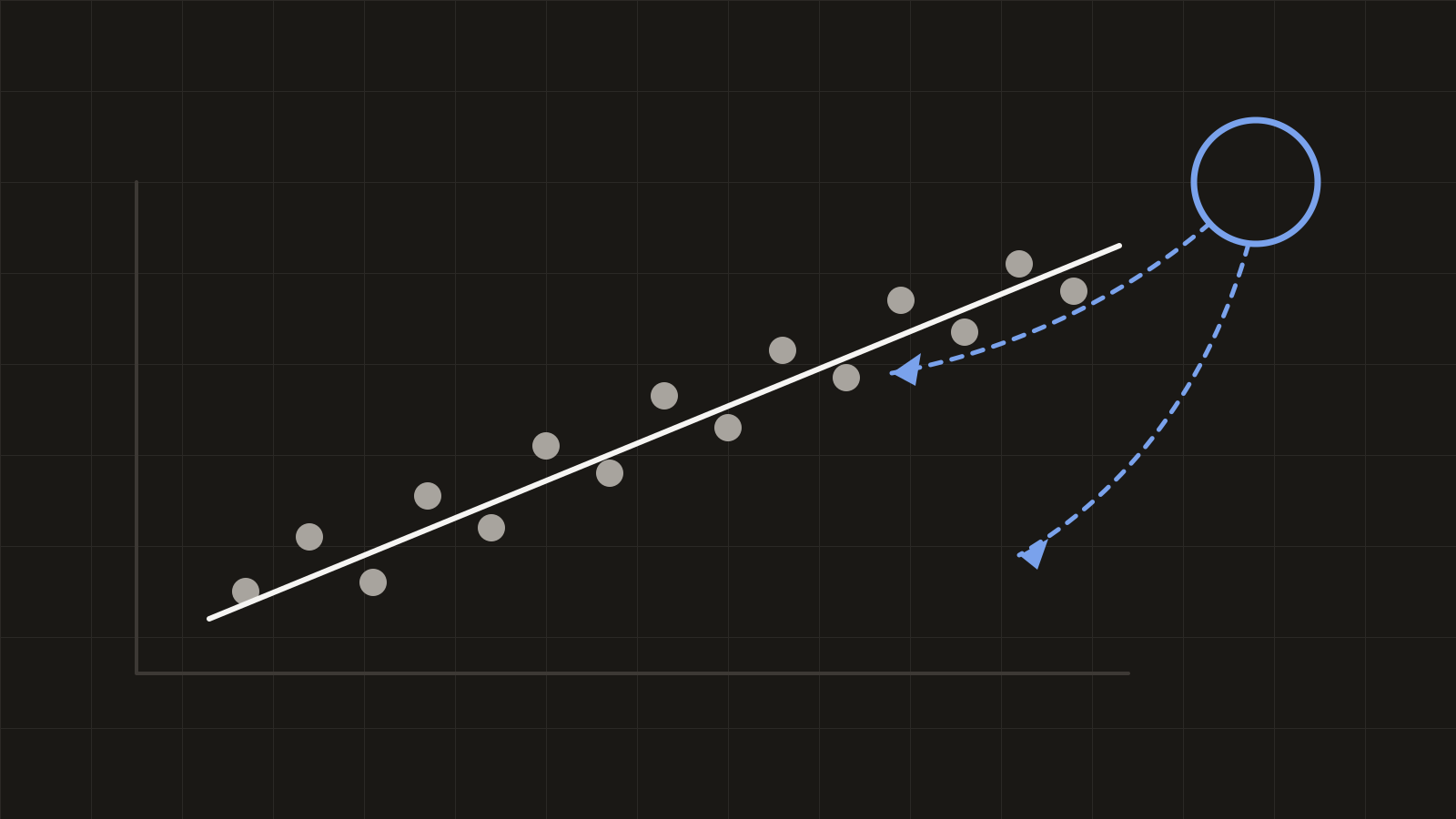
A correlation between two things is compatible with at least three explanations besides causation: confounding by a third factor, reverse causality, and selection effects. Causal claims require designs that rule these out — randomised trials where possible, credible natural experiments otherwise — plus transparent assumptions. ‘Correlation is not causation’ is the beginning of the analysis, not the end.
Everyone has heard that correlation is not causation. The more useful knowledge is why a correlation arises when causation is absent — because each mechanism suggests its own test.
#Three ways a correlation lies
- Confounding. A third factor drives both variables. Ice-cream sales and drowning deaths rise together because summer causes both. In observational health data, socioeconomic status confounds almost everything.
- Reverse causality. The arrow points the other way. Do people become unhealthy because they stop exercising — or stop exercising because they became unhealthy? Cross-sectional snapshots cannot say.
- Selection. The comparison groups formed themselves. People who choose a programme differ from those who do not, in ways usually unmeasured — the core problem randomisation exists to solve, as we explain in our RCT primer.
#What supports a causal claim
The strongest support is design: randomised assignment, or natural experiments in which exposure varied for reasons plausibly unrelated to the outcome. Where only observational data exist, researchers triangulate — checking dose-response patterns, temporal order, robustness to adjustment, and consistency across settings. The epidemiologist Austin Bradford Hill’s famous 1965 “viewpoints” (strength, consistency, temporality, plausibility, and others) remain a useful checklist, so long as they are treated as considerations for judgement rather than a scoring rubric.
#Reading claims in the wild
Practical heuristics: be most sceptical when the claimed cause is something people select into (diets, apps, neighbourhoods); check whether the study design could distinguish direction; and notice whether effect sizes survive adjustment or shrink toward zero as controls improve — a classic signature of confounding. And symmetrically: correlation plus strong design is how nearly everything we reliably know about causes was learned. The slogan should raise the bar for evidence, not lower it to nihilism.
Terms used in this document
How to cite this article
Helsen Institute for Public Research (2026). “Correlation, Causation, and How Public Debate Confuses Them.” Helsen Institute Insight, published July 24, 2026. https://helsen-institute.vercel.app/insights/correlation-causation-public-debate
This work is licensed under CC BY 4.0. You may republish, translate, and adapt it — including for commercial purposes — with attribution to the Helsen Institute for Public Research and a link to https://helsen-institute.vercel.app/insights/correlation-causation-public-debate.
Related from the Institute

Insight
Five Questions to Ask Before Trusting a Statistic
A short checklist — source, definition, denominator, uncertainty, comparison — that catches most misleading numbers before they spread.
Insight
What Makes Research Citable — by People and by Machines
Stable references, explicit dates, open licences and plain summaries determine whether research gets cited accurately, by readers and increasingly by AI systems.